
Common Management Systems
What is the Common Management Systems program?
The CSU Common Management Systems (CMS) program is a systemwide initiative to unify financial operations, human resources, and student operations across every CSU campus on a single platform. For SDSU, this means transitioning to two new systems:

Common Financial System (CFS)
PeopleSoft Finance 9.2, a single financial data management system for all CSU campuses, replacing Oracle E-Business Suite (EBS) and the ASCOT billing system. Includes CSUBUY for procurement and Concur for travel and expenses.

PeopleSoft HCM 9.2, a single human resources data management system for all CSU campuses, covering payroll, benefits, workforce administration, recruiting, and more.
Why does this matter to SDSU?
These systems are the backbone of how SDSU pays its employees, manages its finances, and stays compliant with state and federal regulations. Getting this transition right is not optional. It is foundational to the university's ability to operate.
Being on a shared platform with the rest of the CSU also unlocks real benefits for our campus: access to the CSU Data Warehouse for finance reporting, shared procurement contracts with better pricing, and the elimination of costly legacy systems like Oracle EBS and ASCOT. The CSU system is stronger together, and SDSU's participation strengthens that collective.
This transition will take real effort
We want to be honest with our campus community: transitions of this scale are hard. Replacing core enterprise systems touches nearly every unit on campus. It requires extensive training, changes to familiar workflows, data cleanup, and sustained engagement across divisions. This is not just an IT project; it affects Finance, Human Resources, and everyone who uses these systems every day.
At the same time, the university has experienced a significant increase in cybersecurity threats, a pattern seen across higher education nationwide. Protecting our community from phishing and financial fraud requires the same level of institutional focus as the CMS transition itself.
A pause on major new IT projects
Given the scope of these commitments, SDSU's Vice Presidents for Business & Financial Affairs and Information Technology have recommended a temporary pause on major new IT-dependent initiatives. This includes pausing new software rollouts, major upgrades, and special projects requiring support from the IT Division, Human Resources, and Financial Operations within BFA, unless they are:
- Legally or regulatorily required
- Directly aligned with the CFS or CHRS transition
- Essential to cybersecurity, financial integrity, or institutional risk mitigation
All other initiatives should be deferred and revisited once these foundational efforts are successfully implemented and stabilized.
This is a deliberate sequencing strategy, not a retreat from innovation. Experience shows that large-scale system changes require more than technical work: they demand institutional focus. Adding new projects on top of these mandatory transitions increases the risk of delays, integration failures, and change fatigue across the organization.
Virtual Open Lab
Procure-to-Pay Virtual Open Lab every Friday from 10:00–11:00 a.m. to help campus partners navigate the Oracle-to-CFS, CSUBuy, and Concur 2.0 migration, including questions about purchases, travel, purchase orders, purchase cards, processing timelines, and freeze dates through December 31, 2026.
This is an open forum—not a training session for future-state systems. Formal training will be offered separately.
https://sdsu.zoom.us/j/84800430517
Zoom Sessions
- Oct. 8 — Help Lead a Successful CFS Transition
- Sept. 24 — Get Ready for CFS: New Chart of Accounts and P2P Freeze Dates
CFS Transition Question Form
If you have any questions, please submit them through the CFS transition question form.
Frequently Asked Questions
The CSU Common Financial System (CFS) will use a six-part chart field string: account, fund, department, class, program and project. Account and fund formats will change, department values will remain the same, and class, program and project will provide optional tracking details. In CFS, the Oracle account string generally will be referred to as the “chart field string.”
New Concur PCCs were ordered for current Oracle iExpense cardholders. However, each division is reviewing card usage and business needs, so not every current cardholder will necessarily receive or retain a card after the transition. Please verify this with your divisional resource manager. The appropriate division will provide additional communications about card pickup and continuation.
Current Oracle iExpense PCCs may be used for charges through October 30, 2026, and will be deactivated on October 31, 2026.
The transition team advised that items not completed by the December 4, 2026, reconciliation deadline will need to be restarted using the new CFS chart field string. Final procedures were still being confirmed with the Chancellor’s Office, so please watch for follow-up guidance.
Please attend the Virtual Open Labs, held Fridays from 10 a.m. to 11 a.m., to ask questions and receive support specific to your area. You can also review additional guidance and resources through our CFS Transition Question Form. Training will be provided to campus partners. More information will be provided regularly, so please check this site often.
Please consult our internal FAQ page.
Processing Timelines & Freeze Dates
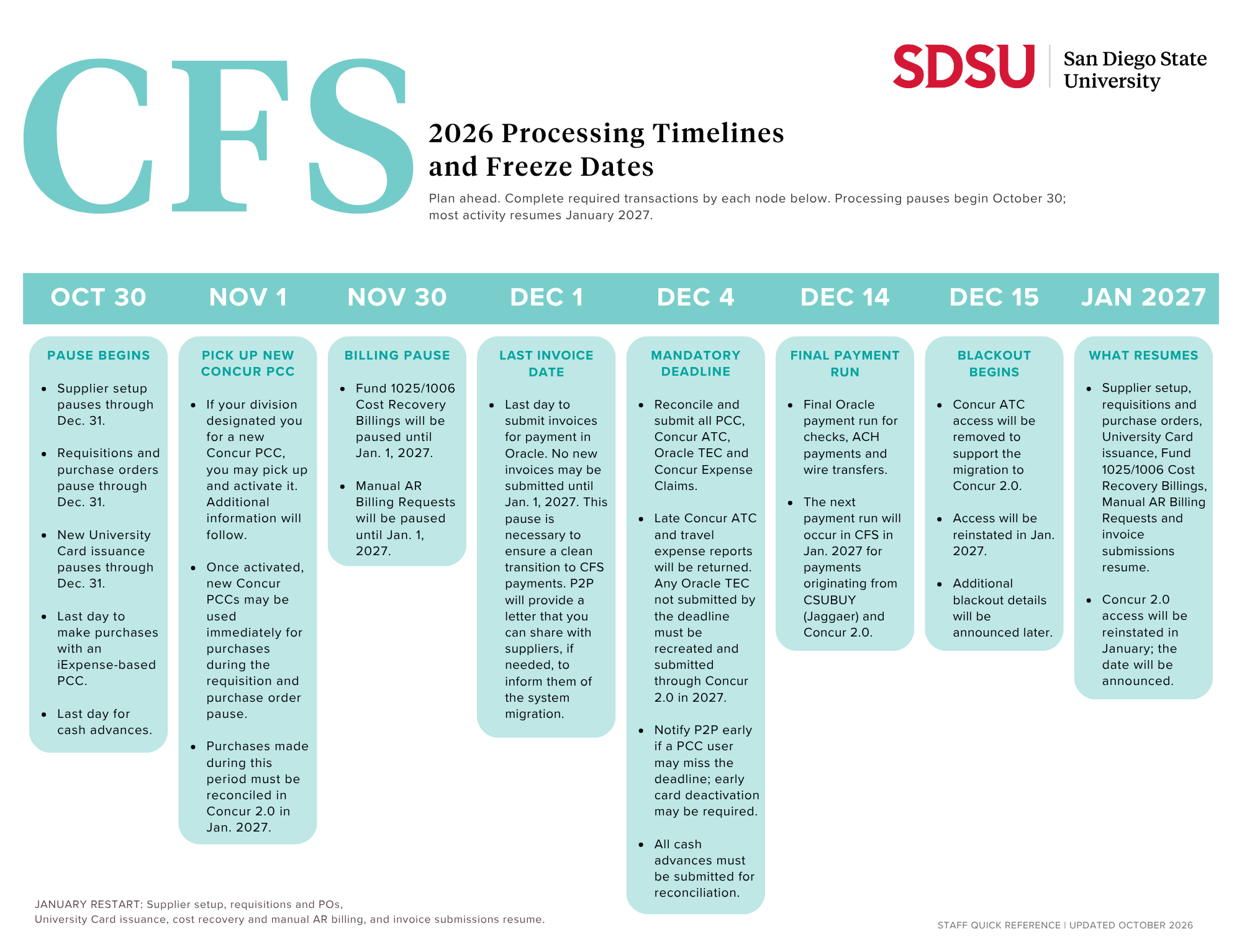
- Supplier setup will be paused until January 1, 2027. This is necessary to ensure the proper migration of supplier data into CFS and CSUBUY (Jaggaer).
- Purchase orders and requisitions will be paused. No new requisitions may be submitted, and no purchase orders may be issued until January 1, 2027, because of the financial rollover from Oracle to CFS.
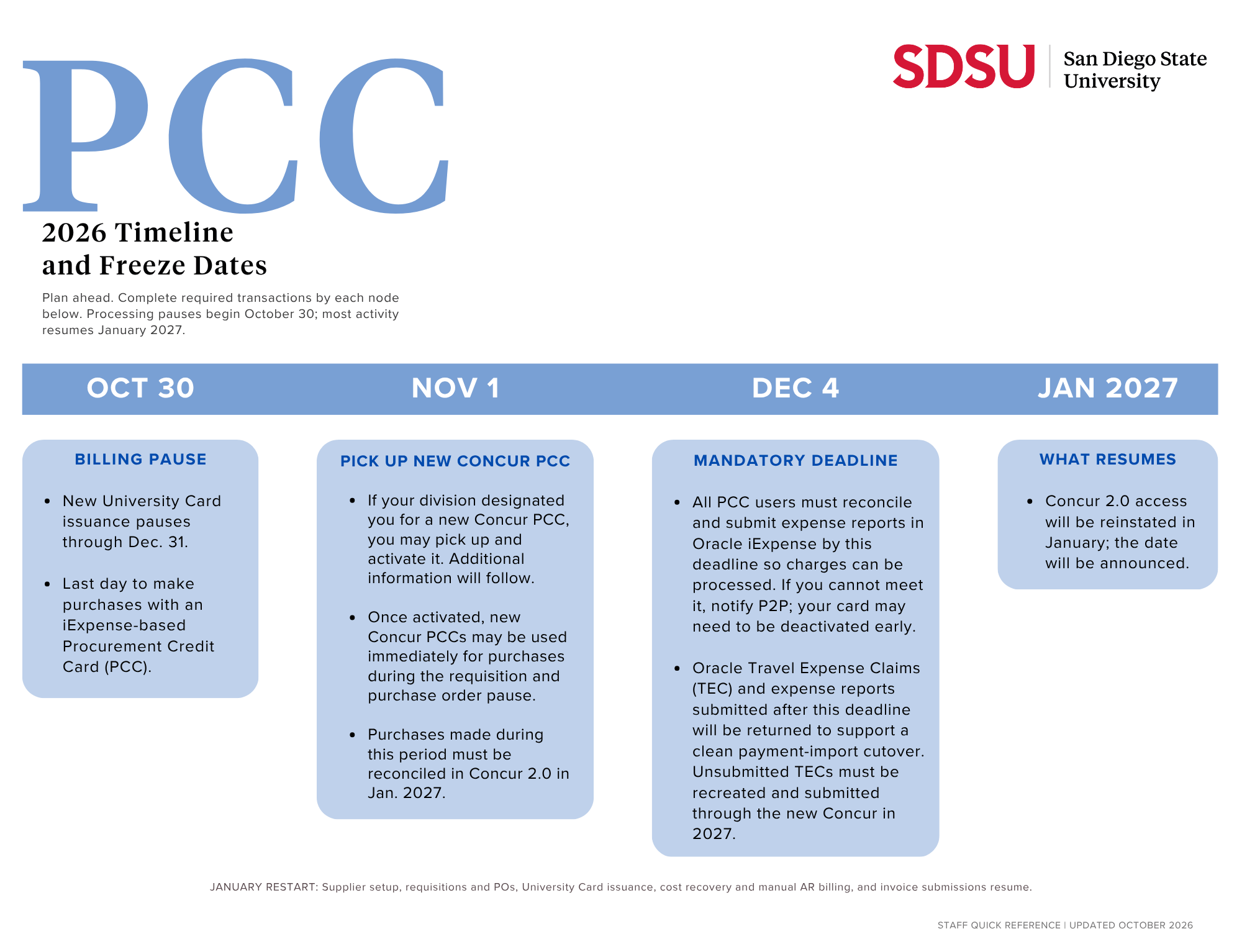
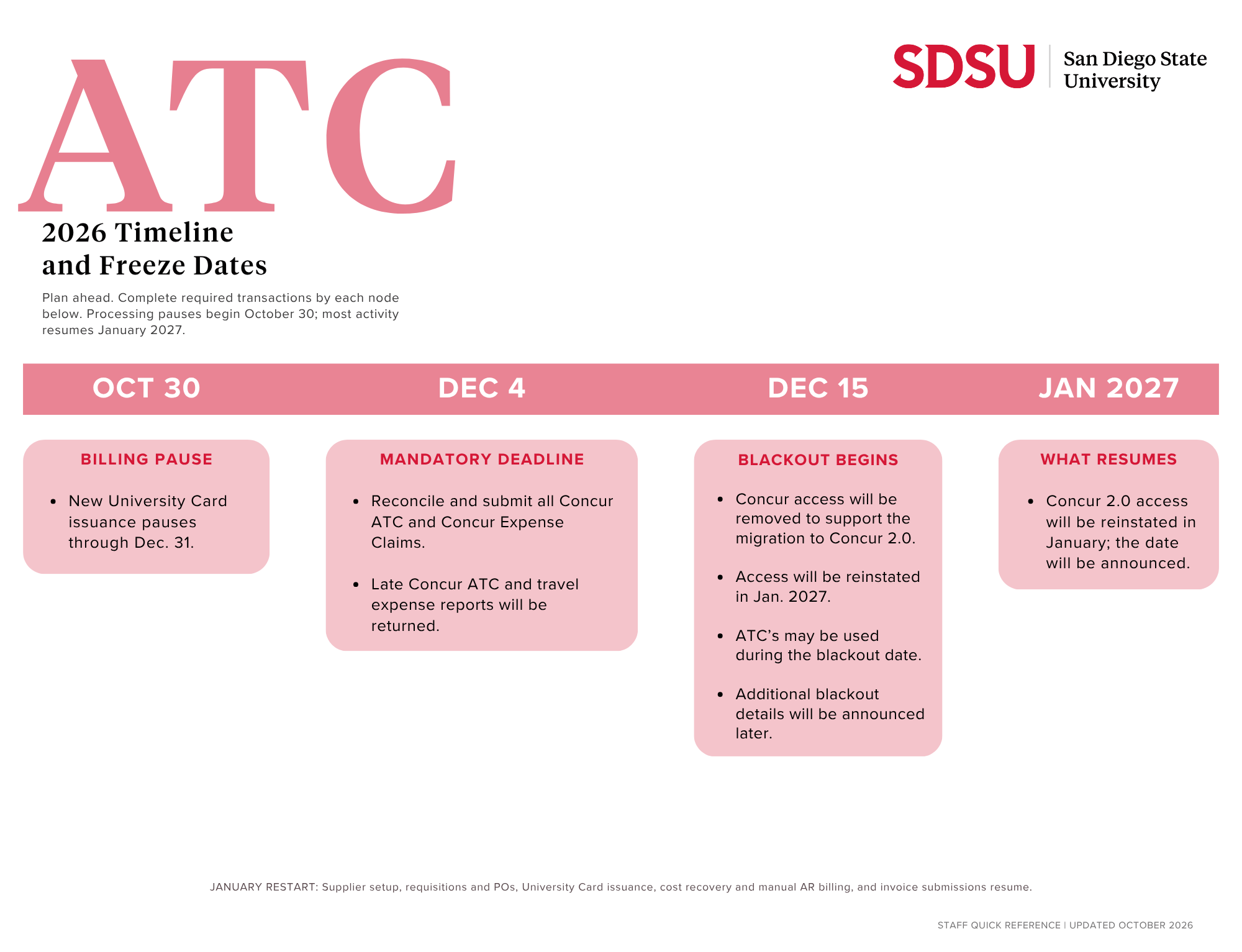
- Issuance of University Cards to new users will be paused until January 1, 2027. This pause will allow U.S. Bank data to be migrated from Oracle to CFS and Concur 2.0.
- Last day to make charges using an iExpense-based Procurement Credit Card (PCC). All PCCs will be deactivated at this time for future purchases. The Oracle credit card program will be decommissioned to make way for the new Concur 2.0 credit card programs. Current cardholders will receive future communications.
- Last day for cash advances of any kind.
- New Concur PCC: If your division has designated you for a new Concur PCC, you will be notified via future communications. Individuals who receive a new Concur PCC will be able to begin using their new cards immediately upon receipt and activation to make purchases during the requisition and purchase order pause. Items purchased during this period will need to be reconciled in Concur 2.0 in January 2027.
- Fund 1025/1006 Cost Recovery Billings will be paused until January 1, 2027.
- Manual AR Billing Requests will be paused until January 1, 2027.
- By 2 p.m., campus partners must complete the following:
- Upload Billing Feed Files into Oracle
- Manually Input AR Transactions into Oracle
- Submit AR Billing Request Forms
- Submit IFT Requests
- By end of day, Accounting Services/AR Team will complete all salary and cost recovery billings for October 2026.
- Last day to submit invoices for payment in Oracle. No new invoices may be submitted until January 1, 2027. This pause is necessary to ensure a clean transition to CFS payments. P2P will provide a letter that you can share with suppliers, if needed, to inform them of the system migration.
- Accounting Services/AR Team will process and distribute:
- All invoices to customers
- All AR aging reports
- PCC: Expense reports must be reconciled and submitted in Oracle iExpense by December 4. This is a mandatory deadline that must be met by every PCC user to ensure that all charges are processed. If you believe a PCC user cannot meet this deadline, please notify P2P; the card may need to be deactivated earlier.
- Concur Aztec Travel Card (ATC): Expense reports must be reconciled and submitted in Concur by December 4. Expense reports submitted after this deadline will be returned to ensure a clean cutover for payment imports.
- Oracle Travel Expense Claims (TEC) & Concur Expense Claims: All travel expense reports must be reconciled and submitted in either Oracle or Concur by December 4. Expense reports submitted after this deadline will be returned to ensure a clean cutover for payment imports. Any TEC that is not submitted by this deadline will need to be recreated and submitted in 2027 through the new Concur 2.0 process. All cash advances must be submitted for reconciliation.
- Accounts Receivable/Billing Freeze Period until Jan. 1, 2027.
- Final Oracle payment run for checks, ACH payments, and wire transfers. The next payment run will take place in CFS in January 2027 for payments originating in CSUBUY (Jaggaer) and Concur 2.0.
- Concur system access will be removed and the blackout period will begin. This will allow for the migration to Concur 2.0. Additional information about the blackout period will be provided at a later date. Access will be reinstated in January 2027.
- November 2026 salary/cost recovery/chargeback file/manual billing requests
- December 2026 salary/cost recovery/chargeback file/manual billing requests
- Creating new AR/billing customers
- Processing IFT requests
Stay Informed
Updates on the CFS and CHRS transitions will be posted here as key milestones are reached. For questions, contact Business and Financial Affairs or the Division of Information Technology.